The Battle of Badr: Genesis of a Power and Victory of Faith.
The 5 key points
The Battle of Badr (624) marks the first major military victory for the Muslims and transforms the community of Medina into a recognized political power. The conflict begins with an attempt to intercept the caravan of Abū Sufyān, in a context of economic reprisals following the Muslims' exile from Mecca. Despite being significantly outnumbered (about 300 against 1,000), the Muslims win the battle thanks to an effective strategy, notably by controlling the wells of Badr. Islamic tradition presents this victory as the result of divine intervention, with angels coming to support the Muslim fighters. Historians consider Badr to be a major turning point, both militarily, politically, and religiously, while emphasizing that the accounts have also served to construct the memory and doctrine of the nascent Islam.
Introduction
The Battle of Badr, which occurred in the 2nd year of the Hijra, is traditionally presented as the first monumental victory of the Muslim community over Meccan aristocracy. More than just a skirmish, this confrontation marks a major geopolitical and theological turning point. Transitioning from a group of vulnerable exiles to a recognized military power, Muhammad's followers redefined the balance of power in the Hejaz. This article analyzes the mechanisms of this confrontation, between economic imperatives, tactical genius, and mnemonic construction.
Origins and Outbreak: The Economic War
The interception of Abū Sufyān's caravan
The origin of the conflict lies in Muhammad’s desire to intercept a significant Quraysh caravan returning from Syria. Under the direction of Abū Sufyān, this convoy carried riches estimated at 50,000 dinars. The Prophet urged his companions to mobilize to seize these goods, which were presented as legitimate spoils in the face of spoliations suffered in Mecca.
Internal tensions and reluctance
Historiography notes that this raid project was not unanimous. Some Muslims expressed doubts, questioning the legitimacy for a prophet to initiate armed action for the sake of spoils. These initial hesitations highlight the complex transition the community was undergoing, moving from a purely spiritual entity to a political entity assuming the offensive.
Strategic Progress and Military Realities
The imbalance of forces
The clash takes place as the Muslims, numbering around 300, face a Meccan relief army of 950 to 1,000 warriors. Despite this numerical inferiority of one to three, the Medinan forces will demonstrate superior discipline and tactical organization.
The tactical expertise of Ḥubāb ibn al-Mundhir
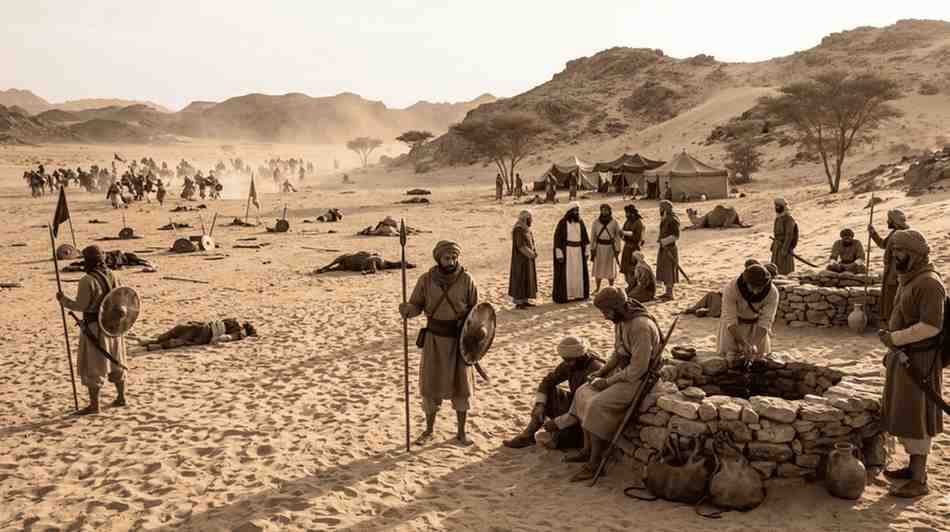
A crucial turning point in the military narrative is the intervention of Ḥubāb ibn al-Mundhir. He suggests to Muhammad to change the army’s position to take exclusive control of Badr’s water wells. By depriving the Meccans of water resources in a hostile desert environment, the Muslims ensured a decisive psychological and physiological advantage.
An unequivocal outcome
The result is a stinging defeat for the pagans: 70 dead, including the leading opponent Abū Jahl, and 70 prisoners. On the Muslim side, only 14 men fall in battle, immediately elevated to the rank of "martyrs" in collective memory.
The Transcendental Dimension: A Founding Miracle
The angelic intervention
Classical accounts incorporate a metaphysical dimension to explain this unexpected success. The appearance of thousands of angels, wearing colored turbans to assist the believers, is a constant in the sources. This divine intervention sanctifies the victory and validates Muhammad’s prophetic mission.
The superiority of Faith over Paganism
For medieval historians, Badr is proof through the sword of Islam's superiority. The victory is not just the result of a successful maneuver over the wells but the sign of a divine election where the "Truth" definitively triumphs over the "False".
Historiographical Analysis and Contextualization
Offense vs Defense: The end of a paradigm
Contrary to some modern apologetic readings tending to present these raids solely as self-defense, ancient sources clearly indicate a deliberate offensive. The raid of Badr aimed to strike the economic heart of the Quraysh and avenge the expulsion of 622. It is this cycle of tribal vengeance that led, in response, to the Meccan retaliation at Uḥud the following year.
The construction of the narrative (Perspective of Ayman S. Ibrahim)
Historian Ayman S. Ibrahim suggests that these accounts should be perceived as literary and religious representations rather than strictly factual battle reports. Fixed mainly during the Abbasid era, these texts aim to establish legal precedents on booty distribution and the framework of jihad, while providing models of piety for future generations.
Conclusion
The Battle of Badr constitutes the birth act of Islam as a political and military power. By breaking the arrogance of the Quraysh aristocracy and consolidating Muhammad's authority in Medina, it transformed a community of believers into a hegemonic force. More than a victory, Badr became the quintessential founding myth, where divine support meets tactical audacity to change the course of Arab history.