Did the divine nature change during the incarnation?
Introduction
A fundamental question runs through the history of Christian theology: if "the Word became flesh" during the Incarnation, does this not imply a change in God? However, immutability is an essential attribute of divinity: "For I, the Lord, do not change" (Malachi 3:6). If God changes, can He still be God?
This issue rests on an apparent tension between divine eternity and the historical event of the Incarnation. To resolve this paradox, it is necessary to delve into the concept of the Hypostatic Union and the distinction between Person and Nature.
Understanding the Hypostatic Union
The Incarnation is not the transformation of God into man, but the assumption of a human nature by a divine Person. The Hypostatic Union denotes that, in Christ, two natures — one divine and one human — exist in a single and unique Person (the Second Person of the Trinity).
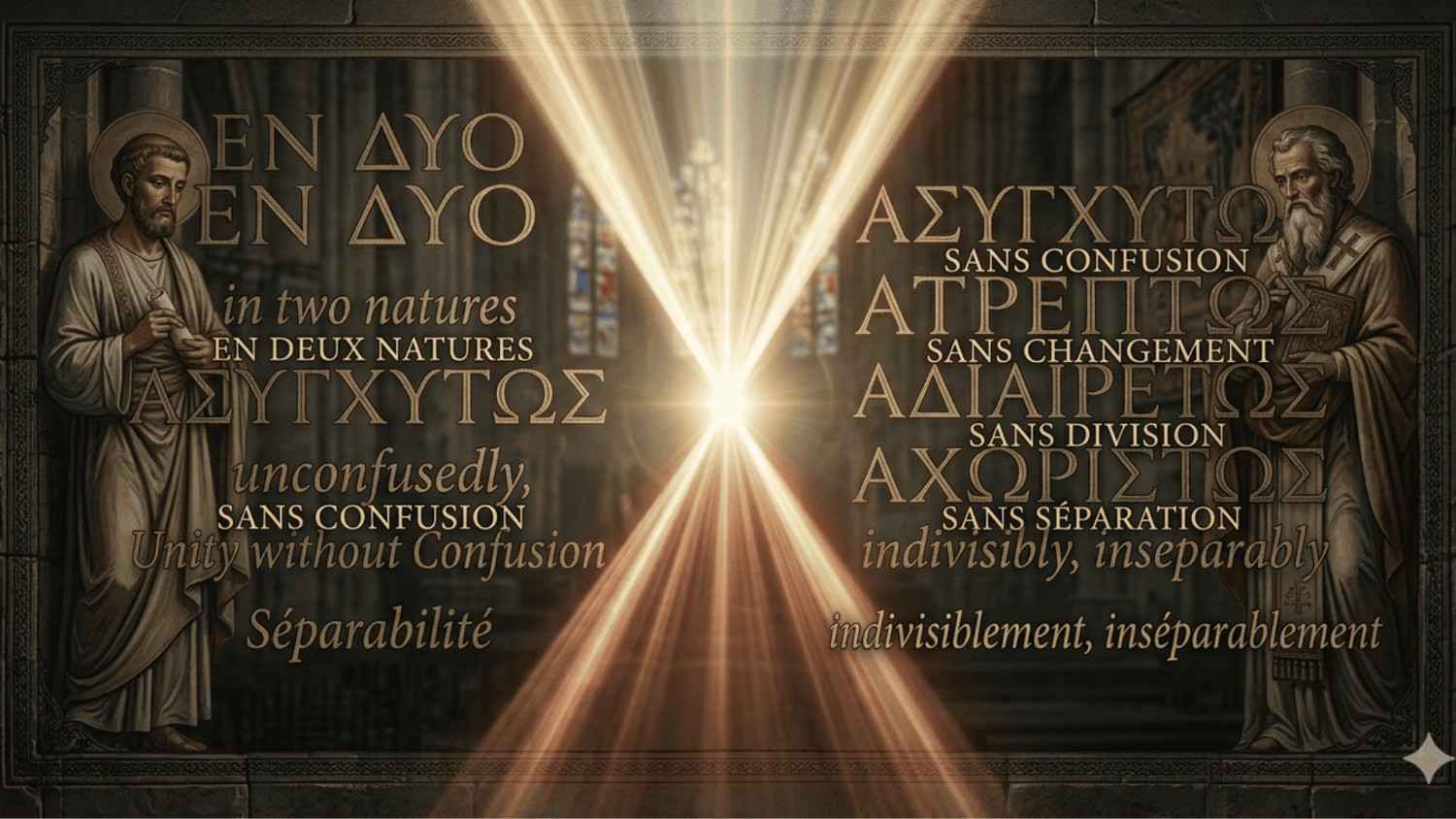
It is crucial to note three rules defined by the Councils of Ephesus and Chalcedon:
No mixture: The two natures remain perfectly distinct in their properties.
No confusion: The divinity does not become humanity, and humanity is not absorbed by the divinity.
Unity of Person: They are united without being separated, having as their sole subject the eternal Word.
The Union: A change in the creature, not in the Creator
To address the objection of divine change, Saint Thomas Aquinas provides a major metaphysical clarification. According to him, since the divine Person is infinite, nothing can be "added" to it to complete it.
Saint Thomas Aquinas's perspective
In the Summa Theologica, the Aquinate explains that the union is not effected by a modification of the divine essence:
"Just as in the union of man to God, nothing is added to God by the grace of adoption, but what is divine is united to man; therefore, it is not God who is completed, but man." (ST III, Q. 3, Art. 1).
A real relation in human nature
Saint Thomas clarifies that the union is a "created relation." Now, every relation between the Creator and the creature produces a real change only in the creature:
"Every relation [...] is, in reality, in the creature, by the change of which this relation arises; whereas it is not really in God [...] it is rather in human nature, which is a creature." (ST III, Q. 2, Art. 7).
Thus, the Incarnation is an event that affects the assumed humanity. It is humanity that is elevated to an infinite dignity by having as its subject a divine Person, while the divine essence remains unchangeable in its eternity.
The distinction between "Who" and "What"
The error of conceiving a change in God often comes from confusion between the Person (the "Who") and the Nature (the "What").
Nature (What): The divine nature does not change. It does not become mortal, limited, or suffering.
Person (Who): The Word (the "Who") assumes a new "What" (the human nature).
Because these two natures are united in one Person, we can attribute human properties to this divine Person. This is known as the communication of idioms. This is how we can affirm:
One can worship the man Jesus Christ because His subject is divine.
One can say that "God died" on the cross, not that the divine nature died, but that the divine Person suffered death in His human nature.
The Testimony of Scriptures: Unity and Fullness
The New Testament presents Christ as simultaneously possessing the attributes of the Creator and the limitations of the creature, without contradiction. In the Epistle to the Colossians (1:15–22), Christ is described as:
The image of the invisible God, through whom all things were created (divine attributes).
The one who reconciled everything by the blood of His cross (human reality of suffering).
The apostle Paul states that "the man, Christ Jesus" (1 Timothy 2:5) is not merely a participant in grace but is the one in whom "dwells all the fullness of the Godhead bodily" (Colossians 2:9). This fullness did not change God but transfigured humanity by uniting it to the source of life.
Conclusion
In summary, the Incarnation does not mean that God ceased to be what He was to become something else. There was no change in the essence of divinity but a new and gratuitous union with human nature.
As the rigorous tradition of the Church teaches, it is man who has been changed by God, not God by man. We can therefore confidently confess the mystery of salvation: God became man, and yet God does not change.