The People of the Cave: A Comparative Study between the Quranic Narrative and the Legend of the Seven Sleepers of Ephesus.
The 5 Key Points
The Quranic narrative of the People of the Cave presents many similarities with the Christian legend of the Seven Sleepers of Ephesus, known in the Syriac traditions of Late Antiquity. The Quran adopts this story while redirecting it towards its own message, centered on the oneness of God (Tawhid) and resurrection. Some details, such as the dog, the length of sleep, or al-Raqīm, show that the Quran is part of an existing oral and written tradition, while introducing its own variations. Scholars believe that this legend may itself originate from older Jewish traditions before being adapted by Christianity and then by the Quran. From the Quranic perspective, the awakening of the sleepers becomes above all a sign of resurrection and the Last Judgment, rather than just a historical or miraculous story.
Introduction
The story of the "People of the Cave" (Aṣḥāb al-Kahf), recorded in the eighteenth surah of the Quran (verses 9 to 26), remains one of the most fascinating episodes of Islamic tradition. For historical exegesis, this passage maintains a close intertextual dialogue with a Christian legend of Late Antiquity: that of the Seven Sleepers of Ephesus. The aim of this study is to understand how the Quranic text appropriates, reformulates, and theologically reorients a pre-existing narrative to integrate it into its own monotheistic message. Through the analysis of Syriac sources, narrative details, and eschatological aims, we will explore the points of convergence and semantic ruptures between these two traditions.
Syriac Roots and the Emergence of the Legend
The oldest written trace of this wonder dates back to the sixth century. It is traditionally attributed to Bishop Jacob of Sarug (died in 521), a major figure in Syriac literature.
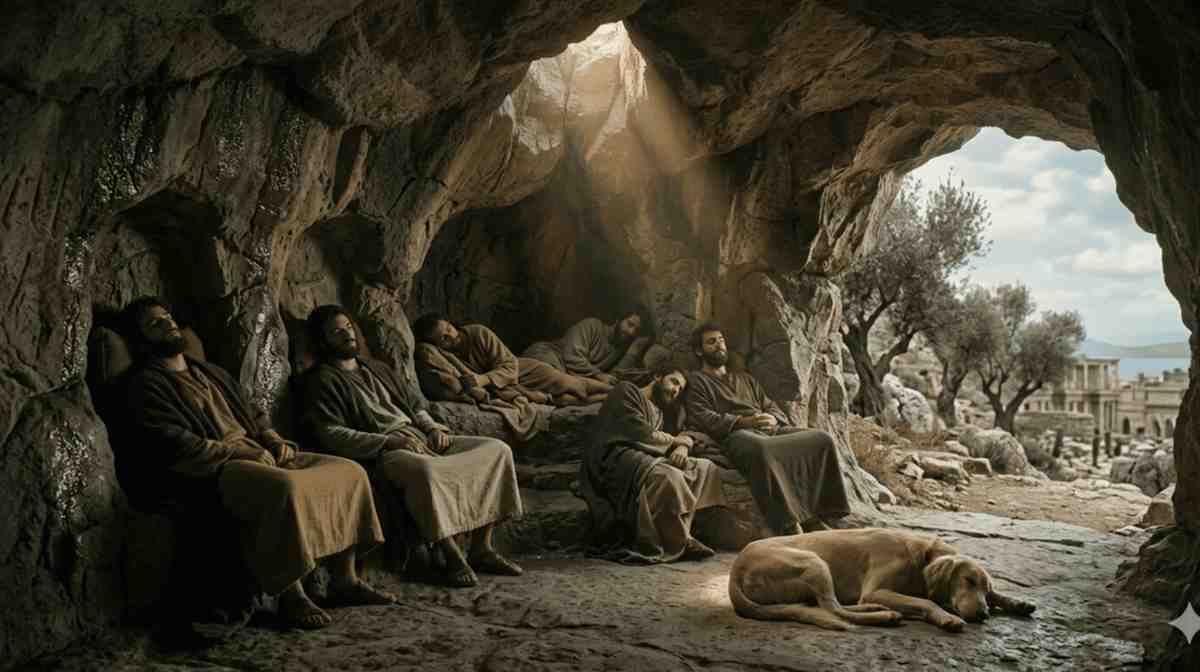
The story recounts the epic of a group of young believers who, to escape the persecutions of the emperor (often identified as Decius), choose to take refuge in a cave to preserve their faith in divine Unity. They fall into a lethargic sleep for several centuries before being miraculously awakened during a Christian reign. In ecclesiastical tradition, this miracle was originally intended to refute doubts about the resurrection of the flesh, a dogma then debated within Byzantine Christianity.
The Architecture of the Quranic Narrative: Details and Enigmas
The Quran structures its narration in two distinct phases: a descriptive phase laying the foundations of the story (v. 10-20), followed by a discursive phase dealing with the controversies surrounding the event (v. 21-26). Several specific elements capture the attention of researchers:
The Enigma of "al-Raqīm"
Verse 9 jointly mentions the Cave and "al-Raqīm." The interpretation of this term is the subject of lively academic debates. Some see it as a text—possibly the lead tablets listing the names of the sleepers mentioned in Syriac sources—while others, relying on etymology, suggest a toponym referring to the Nabataean city of Petra.
The Presence of the Dog
A notable divergence appears with the introduction of a dog lying at the threshold of the cave (v. 18), whereas Jacob of Sarug mentioned an angel or a guardian. However, this detail is not foreign to the Christian world: traces are found in oral folklore and pilgrimage guides, notably that of Theodosius in the sixth century, suggesting that the Quran draws from a living and plural tradition.
Theological Nuances and Mechanisms of Preservation
The Quranic text enriches the story with cosmological details absent from Christian hagiographic versions, aiming to emphasize God's omnipotence over the laws of nature.
The Management of Light: The Quran specifies that the cave's orientation prevented the sun from directly entering it (v. 17), thereby protecting the bodies from decomposition.
The Physiology of Sleep: The story describes how God would turn the sleepers onto their right and left sides, a quasi "biological" explanation of the physical preservation of the bodies during these centuries of stillness.
Time and Number: Contrary to fixed versions, the Quran highlights the futility of debates about the exact number of young men (v. 22), asserting that only God possesses perfect knowledge. As for the length of sleep, it is set at "three hundred years, to which they added nine" (v. 25).
Intertextuality and Apocryphal Heritage
Comparative analysis reveals that the theme of "long sleep" is part of a broader folkloric framework than the Christian world alone. A striking parallel is drawn with the Jewish apocryphon 4 Baruch, where Abimelech falls asleep for sixty-six years to escape the sight of Jerusalem's destruction. Historians thus suggest that the legend of the Seven Sleepers of Ephesus might be a Christianization of an earlier Jewish literary motif, with the Quran acting as the last link in this inter-religious transmission.
Polemic Issues: A Correction of Dogma
Far from being a simple fable, the story of the People of the Cave fulfills a precise apologetic and polemical function within Surah 18.
A Response to the Dogma of Filiation
The surah begins with a firm condemnation of those who attribute progeny to God (v. 4). By reinvesting a legend dear to Christians, the Quran turns the argument to demonstrate that divine power requires no intermediary or filiation: He is the One who gives life, death, and resurrection.
The Sign of the Hour
The awakening of the sleepers, unable to estimate the length of their stay (v. 19), serves as a parable on human unawareness of the post-mortem state. This miracle is presented as irrefutable proof of the Hour's imminence and the Last Judgment, reminding that the passage of earthly time is illusory compared to divine eternity.
Conclusion
Often referred to by specialists as the "Apocalypse of Islam," the surah Al-Kahf transforms a hagiographic tradition of Late Antiquity into a metahistorical demonstration. By purifying the story of the Seven Sleepers of Ephesus of its purely local elements to extract a lesson on Oneness (Tawhid) and resurrection, the Quran performs a powerful theological synthesis. It does not merely recount a past miracle but uses it to call humanity to reflect on its future destiny and its relationship with the Creator.