The Sīra between History and Theology: A Critical Analysis of the Biographical Traditions of Muhammad
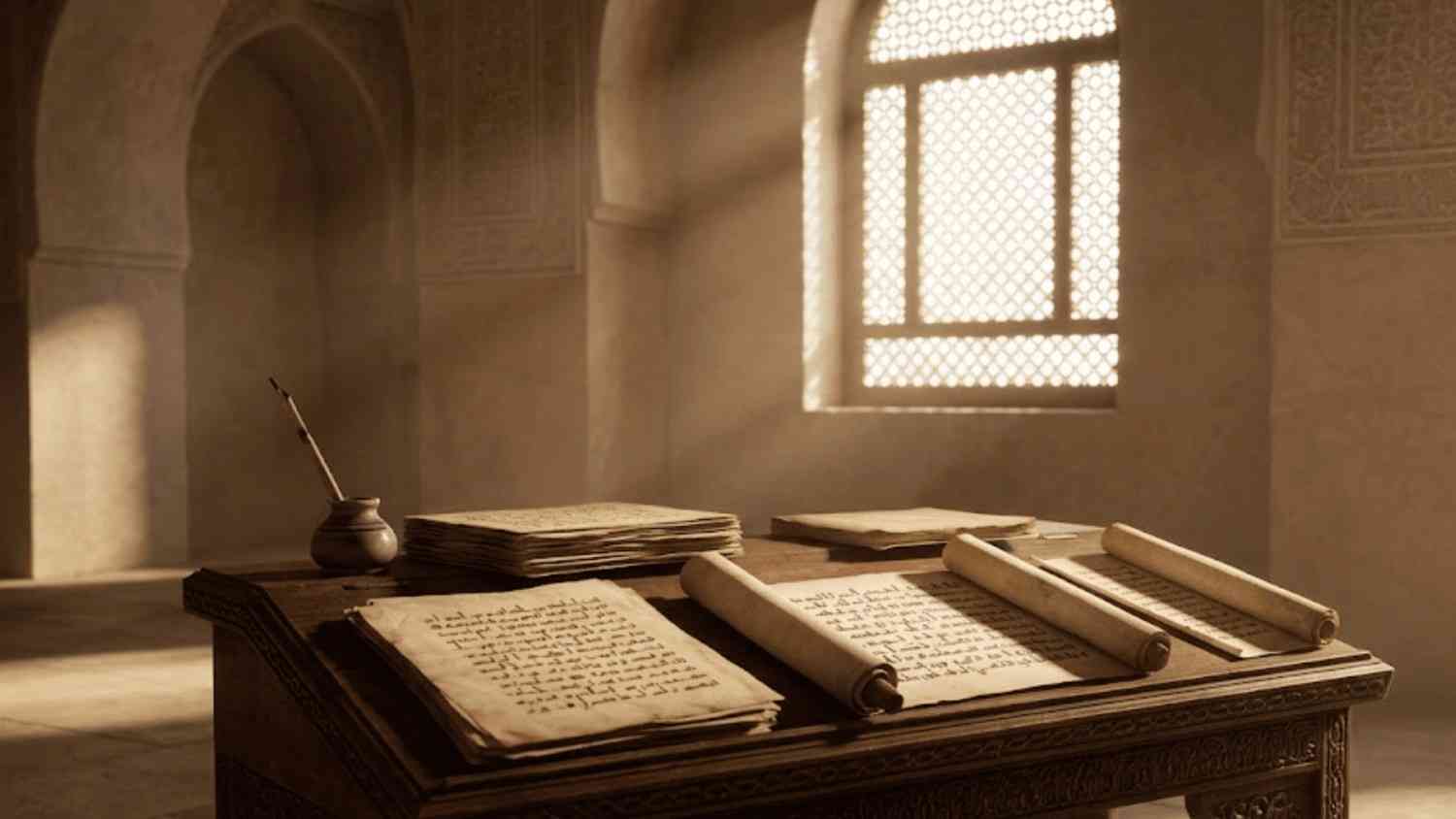
The 5 Key Points
The Sīra is considered by many scholars as a composite narrative mixing history, traditions, legends, and theological issues, rather than a perfectly homogeneous biography.
Several major episodes (youth of Muhammad, Hijra, context of Jāhiliyya) present divergent versions, suggesting a progressive elaboration of the tradition.
The portrayal of Muhammad oscillates between spiritual prophet and political and military leader, with narratives sometimes difficult to reconcile with each other.
The Sīra attributes many miracles to Muhammad, while the Quran mainly insists on his human condition and his mission as a messenger.
According to historical analysis, these evolutions reflect the desire of the early Muslim generations to adapt Muhammad's biography to the theological, legal, and political needs of a community that became an empire.
Introduction
The study of the Sīra Nabawiyya, the traditional biography of the Prophet of Islam, constitutes a major field of investigation for history and comparative theology. Far from presenting itself as a perfectly linear and monolithic document, it is often described by historians as a "textual spiderweb." This metaphor highlights a complex narrative interwoven with historical data, legendary elements, and theological or ideological imperatives, making Muhammad's figure sometimes difficult to grasp unambiguously. For contemporary research, these narrative divergences are not simply inadvertent errors of transmission. Instead, they represent the traces of a historical writing process, elaborated to respond to political and religious issues arising after the Prophet's life. Therefore, the central problem lies in how these textual tensions reveal the evolution of nascent Islamic thought and its confrontation with surrounding religious models.
Disparities and Areas of Obfuscation in the Narrative Chronology
This section examines the temporal structure of the prophetic biography, characterized by significant contrasts between different stages of Muhammad's life.
First, the first forty years of Muhammad remain largely obscure in contemporary documentary sources. The biographical tradition seems to have omitted or reformulated certain details of his pre-Islamic past to make it fully conform to the later theological developments of Islam. In this regard, uncertainties surrounding the names of his sons born before the start of his prophetic mission—especially one who would have been named ‘Abd Manāf, explicitly referencing a deity of the Meccan pagan pantheon—suggest an attempt to smooth elements of a past marked by the polytheistic environment of the time.
Moreover, the Hijra, a foundational event of the Islamic calendar and community, is subject to irreconcilable narratives. The traditions oscillate between evoking a forced expulsion, a strategically well-planned departure after lengthy negotiations, or a hasty nocturnal flight to evade an assassination attempt. The Quranic text itself echoes these narrative hesitations.
Finally, the conceptualization of Jāhiliyya (the pre-Islamic period of "ignorance") raises questions. While the Sīra often describes Mecca as a hotbed of fanatical persecution, it simultaneously preserves evidence depicting a pluralistic and relatively tolerant society. Within this framework, Muhammad was able to coexist and dialogue during the first ten years of his preaching with Christian populations and independent monotheists (Hanifites), without his safety being structurally compromised.
The Duality of the Prophetic Portrait: Between Hagiography and Political Realism
The character of Muhammad in the Sīra presents a changing nature, comparable to a portrait whose nuances vary according to the angle of analysis adopted.
On the military front, while tradition exalts the figure of the warrior Muhammad through the literary genre of Maghāzī (accounts of expeditions), critical historical analysis tempers this image. Textual data indicate he personally fought only once, during the Battle of Uhud, and that in a purely defensive context. The multiplication of raiding narratives in the later literature thus appears as a memorial amplification, intended to legitimize the territorial expansionism of the Umayyad and Abbasid Islamic empires.
This duality is also reflected in the moral behavior attributed to him. The texts continually oscillate between the description of a man of great sensitivity, showing deep clemency toward his relatives, and that of an uncompromising head of state, ordering the execution of war prisoners or satirical poets. In this perspective, prophetic clemency sometimes appears more as a choice of political strategy than as a constant character trait.
Similarly, the narratives oppose the model of absolute asceticism—depicting a Prophet living in deprivation, personally repairing his possessions, and dying in debt—to a tradition describing his attraction to perfumes, refined dishes, and the establishment of a significant harem, mirroring the courtly customs of Eastern rulers of Late Antiquity.
The Sīra vs. the Quranic Text: Theological Discrepancies and Influences
A major axis of study in comparative theology lies in the observed discrepancy between the assertions of the Quran and the later developments of the prophetic biography.
The status of miracles is the most telling example. On several occasions, the Quranic text insists on Muhammad's purely human condition, defined as a warner devoid of supernatural powers. In contrast, the Sīra breaks free from this theological reserve to attribute to him a multitude of miracles (multiplication of food, healing of the blind, springing water from rocks). These narratives are visibly modeled on the biblical figures of Moses and Jesus, reflecting the Islamic tradition's apologetic desire not to appear inferior to the earlier monotheistic religions.
The Prophet's end of life illustrates a similar ambiguity. The causes of his death remain uncertain in the texts: while some versions mention an agony due to a natural illness, others introduce the episode of poisoning by a Jewish woman at Khaybar, which occurred three years earlier. Although this second version conflicts with chronological and biological inconsistencies, and contrasts with accounts showing the Prophet dying peacefully in the arms of his wife ‘Ā’isha, it allowed Muhammad to be granted the prestigious status of martyr (shahīd).
Critical and Theological Analysis
From a theological and historical point of view, these internal tensions should not be interpreted polemically but as reflections of the doctrinal debates that stirred the early centuries of Islam. The transition from a minority community to a universal empire required a rewriting of the founder's life to provide legal, ethical, and military precedents. The Sīra thus served as a tool of harmonization: it had to simultaneously anchor the Prophet in the lineage of biblical figures to engage in dialogue with Judaism and Christianity, and legitimize the political and imperial structures of a burgeoning state.
Conclusion
In conclusion, the Sīra resembles what historian Hela Ouardi describes as a "biofiction," that is, a composite textual space where multiple layers of memory coexist rather than an original unified document that has been altered. The figure of Muhammad appears split between two distinct theological and political functions: the messianic and spiritual prophet of the Meccan model, and the head of state and legislator of the Medinan model. Far from weakening the value of the prophetic biography, these contradictions constitute its very historicity. They attest to the meticulous manner in which an empire's religion structured and articulated its past to assert its theological and political legitimacy in the face of history.
This article offers a synthesis of ideas developed in the book "Le Mahomet des historiens." To delve deeper into the subject, we invite you to consult the original work.