The Episode of Banū Qurayẓa: Disruption and Consolidation of Power in Medina
The 5 Key Points
The affair of the Banū Qurayẓa is part of a series of conflicts that had already led to the expulsion of the Banū Qaynuqāʿ and the Banū al-Naḍīr, against a backdrop of accusations of treason. After the Battle of the Trench, the Banū Qurayẓa were besieged for several weeks before surrendering unconditionally. The arbitrator Saʿd ibn Muʿādh delivered a verdict validated by Muhammad: execution of the men of fighting age, enslavement of the women and children, and confiscation of the property. According to traditional sources, this victory helped strengthen the Muslim community through the distribution of the loot, the sale of some captives, and the consolidation of power in Medina. Historians still debate this episode, particularly regarding the scale of the massacre, the reliability of the reported figures, and the theological and political function of this narrative in Islamic tradition.
Introduction
The year 5 of the Hijra (627 AD) marks a radical turning point in the socio-religious organization of Medina. The raid against the Banū Qurayẓa was not an isolated event but represented the tragic culmination of a process of deterioration in relations between Muhammad and the three main Jewish tribes of the city. This episode raises fundamental questions about the transition between traditional tribal alliances and the emergence of an exclusive Islamic sovereignty. Here, the dynamics of this confrontation, the course of the siege, and the historiographical implications of this narrative within the Muslim tradition will be analyzed.
A Cycle of Tensions and Expulsions
The episode of the Banū Qurayẓa is part of a chronology of successive confrontations. Before this event, two other major Jewish tribes had already been evicted: the Banū Qaynuqāᶜ, expelled after the Battle of Badr, and the Banū al-Naḍīr, following the Battle of Uḥud.
In Islamic historiography, these measures are systematically presented as responses to growing hostility or acts of treason. During the "Battle of the Trench," the position of the Banū Qurayẓa appears ambiguous in the sources. While some accounts mention their initial participation in the city's defense works, the predominant version insists on a secret collusion with the confederates (aḥzāb) who came to besiege the Muslims. From this perspective, a metaphysical intervention precipitated the outcome: the angel Gabriel supposedly appeared to Muhammad right after the withdrawal of the confederates to urge him to march immediately against the Qurayẓa.
The Siege and the Arbitration of Saᶜd ibn Muᶜādh
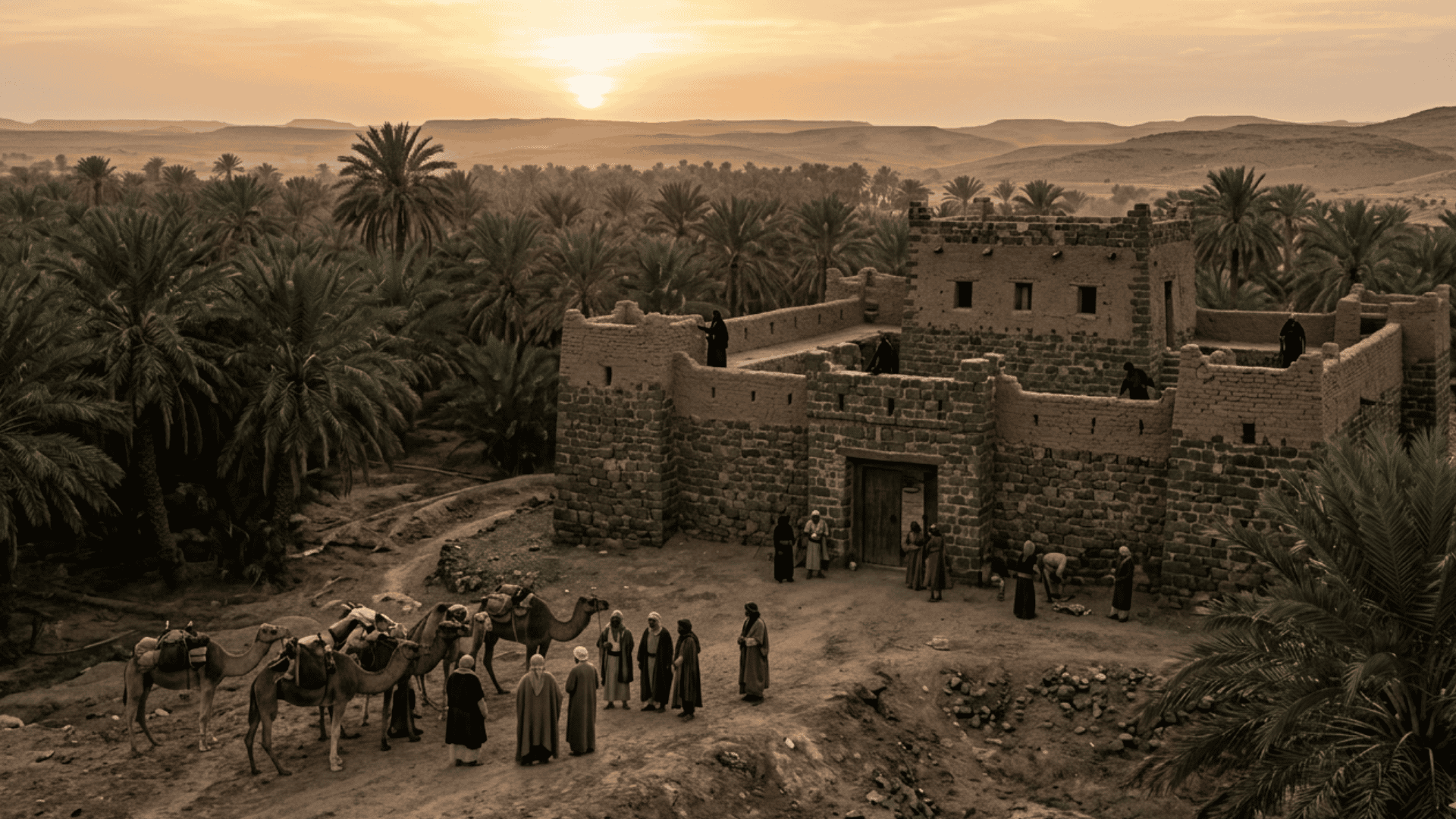
Facing the advance of Muslim forces, the Banū Qurayẓa took refuge in their fortresses. After a grueling siege of about twenty-five to thirty days, the tribe finally surrendered unconditionally.
The legal turning point of this event lies in the choice of arbitrator. Hoping for clemency through their old alliances, the tribe members requested to be judged by Saᶜd ibn Muᶜādh, the chief of the al-Aws. However, Saᶜd, although gravely injured, delivered an absolutely severe verdict: execution of the men of fighting age, enslavement of the women and children, and confiscation of property. This verdict was validated by Muhammad, who saw it as the very expression of the divine decree.
Material Consequences and Consolidations
The implementation of the sentence resulted in major consequences for the structure of Medina. Sources report the execution of 600 to 900 men in trenches dug in the marketplace. This outcome allowed for significant redistribution of resources: the spoils were shared among the Muslim fighters, and part of the captives was sold to acquire mounts and armaments, thereby reinforcing the nascent community's military power.
It was also in this context that Muhammad chose Rayḥāna bint Zayd among the captives. Accounts differ on her final status—wife or concubine—and the modalities of her conversion, illustrating the complexity of human and legal relationships in the aftermath of the conflict.
Historiographical Analysis and Critical Issues
Modern examination of this raid requires a nuanced approach, distinguishing the historical fact from its narrative construction:
Pedagogical Dimension: Researchers like Ayman S. Ibrahim emphasize that these accounts primarily serve to illustrate a theological rupture. They teach that loyalty to Islam and its prophet must now take precedence over preexisting tribal solidarities.
Religious Controversy: Medieval sources often use this episode to forge a negative image of Jewish opposition, depicted as being aware of the truth of Muhammad's prophetic mission but choosing to reject it out of malice.
Contemporary Debates: The extent of the massacre remains a subject of intense discussion. While some scholars justify the act by the rules of 7th-century warfare, others question the statistical reliability of traditional sources, suggesting a possible symbolic amplification of the numbers.
Conclusion
In summary, the demise of the Banū Qurayẓa marks the definitive erasure of organized Jewish presence within the oasis of Medina. By eliminating this last internal opposition, Muhammad consolidated his political and religious authority, transforming Medina into a completely unified base. This power base allowed him, shortly thereafter, to extend toward peripheral Jewish settlements, notably Khaybar, marking a new chapter in the expansion of Islam in Arabia.