Saint Polycarp: The Golden Link of Apostolic Tradition
Introduction
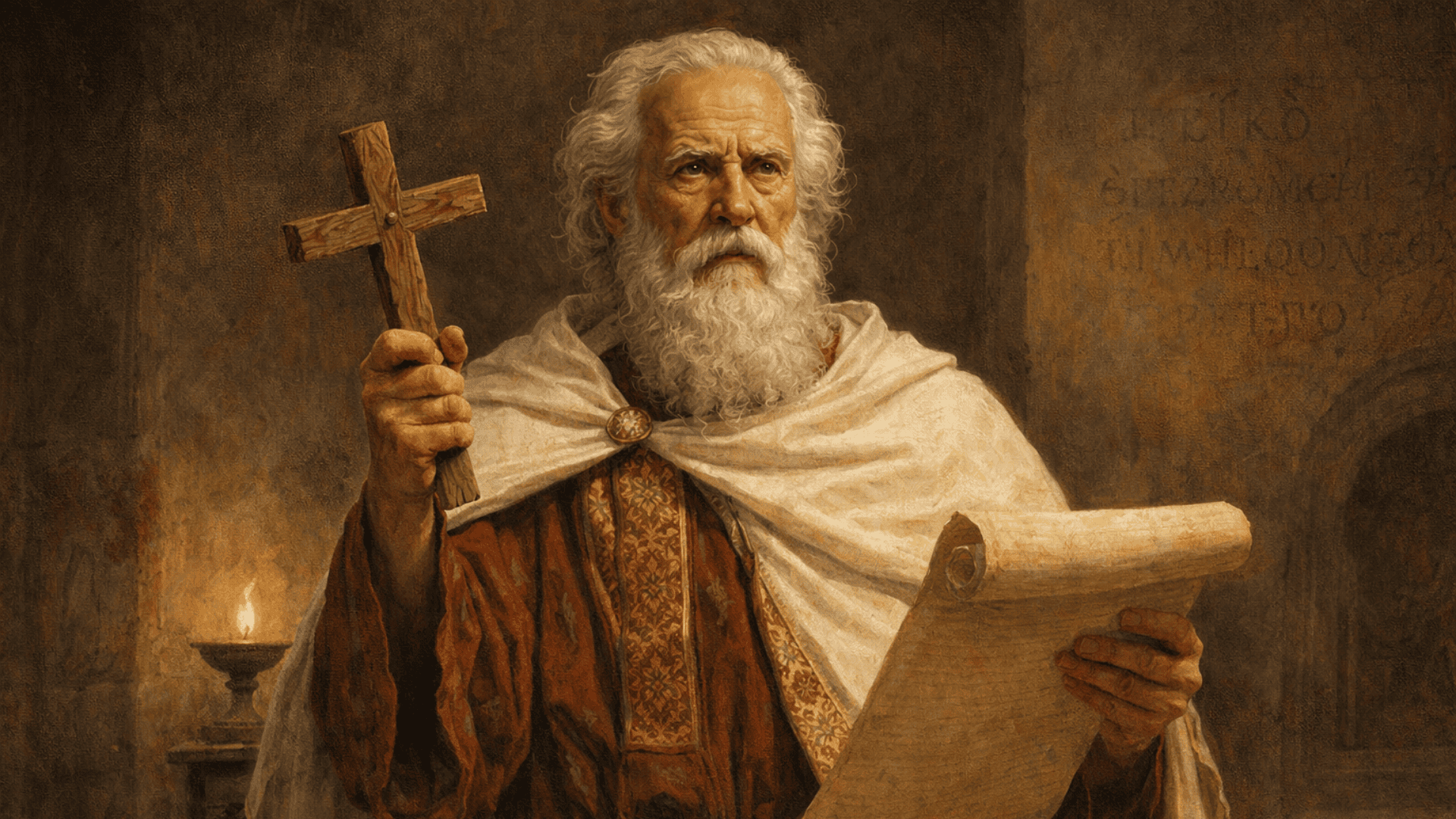
In the history of the early Church, certain figures shine with a particular brilliance not only because of their holiness but because of their role as direct witnesses. Saint Polycarp of Smyrna is one of them. Although he does not have a dedicated chapter in this collection, he appears through the accounts of other great Fathers as an essential pivotal figure.
A disciple of the Apostle John
Polycarp holds a unique place because he represents the living link with the Apostles. Sources tell us that he was a disciple of Saint John.
For generations that followed, he was the one who had heard the preaching of the eyewitnesses of Christ. Saint Irenaeus of Lyon, who was his pupil, loved to recall that Polycarp often recounted his conversations with John and with others who had seen the Lord.
Polycarp and Ignatius of Antioch: A friendship in martyrdom
One of the most notable stages of Polycarp's life was his encounter with Saint Ignatius of Antioch. While Ignatius was being taken in chains to Rome to be delivered to the beasts, he stopped over in Smyrna, where Polycarp was bishop.
From this meeting was born a deep spiritual affection. Ignatius even addressed a personal letter to Polycarp, entrusting him with his fate and encouraging him in his pastoral mission.
In his writings, Ignatius exhorts Polycarp and his Church to remain united: "Work together for each other, struggle together, run together."
The mentor of Saint Irenaeus of Lyon
Polycarp's influence extends far beyond Asia Minor. It was he who trained Saint Irenaeus, the future bishop of Lyon and the first great systematic theologian.
Thanks to Polycarp, Irenaeus was able to assert that the doctrine he defended against heresies was not an invention, but the simple faith received from the Apostles. This unbroken chain—from Jesus to John, from John to Polycarp, and from Polycarp to Irenaeus—constitutes the foundation of what we call the Apostolic Tradition.
Why does Polycarp still speak to us today?
Polycarp embodies fidelity. In a world where ideas changed quickly, he remained the guardian of the "freshness of faith." He reminds us that Christianity is not an abstract philosophy, but an encounter transmitted from person to person.
Studying Polycarp is to return to the source and understand that our faith rests on the testimony of those who, like him, dedicated their lives to the service of Truth.