The Divinity of Christ before Nicaea: The Testimony of 2nd Century Sources
Introduction
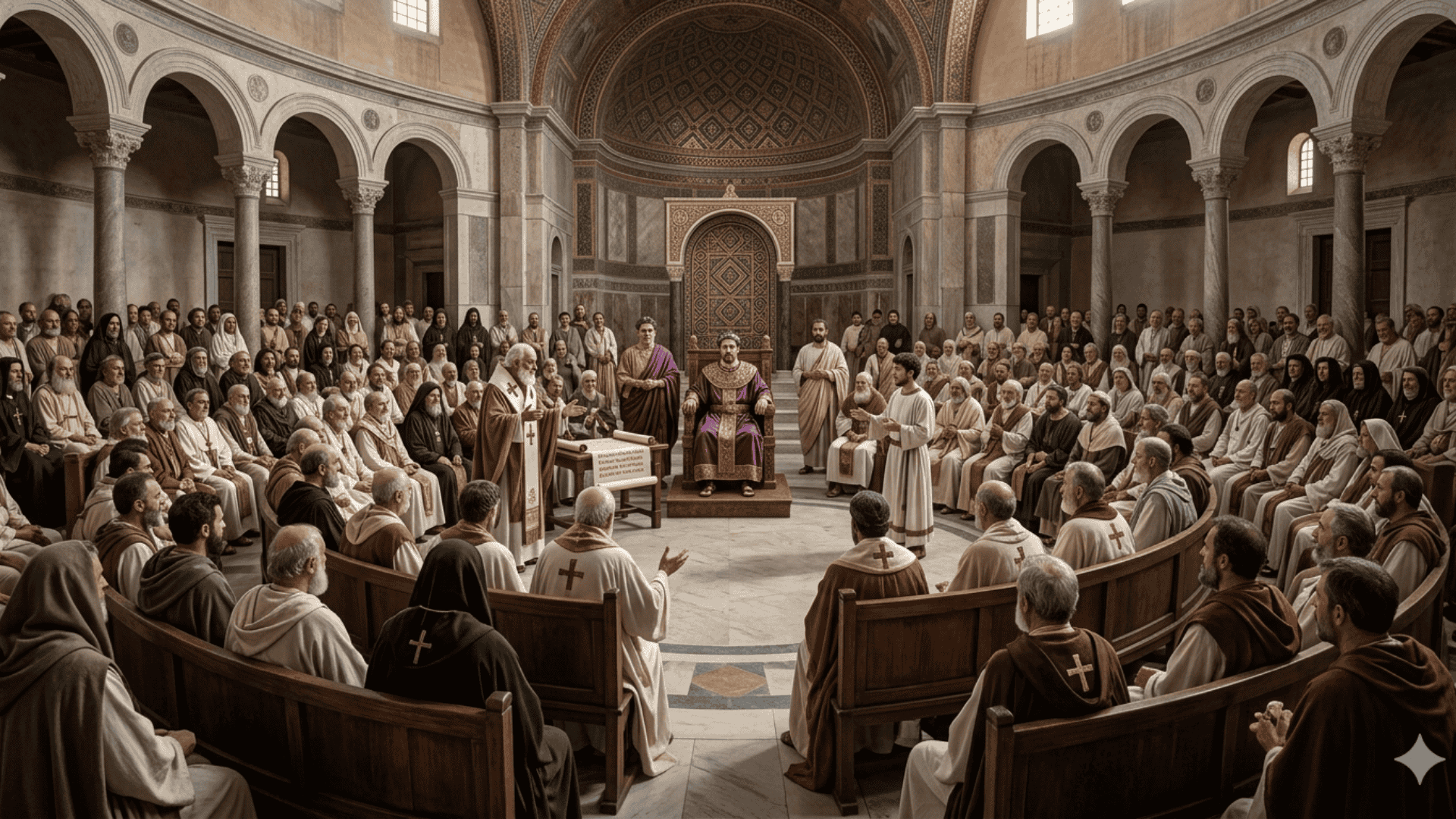
A widely held thesis in certain heterodox currents and critical circles argues that the divinity of Jesus Christ was a late "invention." According to this narrative, this dogma was imposed at the Council of Nicaea in 325 AD, under the influence of the imperial power of Constantine, thus marking a break with the original faith of the apostles.
However, a rigorous examination of the textual sources of the New Testament and the writings of the early Church Fathers contradicts this reading. While metaphysical vocabulary has been refined over the centuries, the assertion of Jesus as Theos (God) is solidly anchored in Christian tradition from its earliest beginnings. This study aims to trace the use of this title through second-century testimonies, long before the fourth-century conciliar formulations.
Scriptural Heritage: The Foundation of the New Testament
Before analyzing the second century, it should be remembered that New Testament writings explicitly use the term Theos to designate Christ. Fundamental passages such as the Logos hymn (John 1:1–14), Thomas's confession (John 20:28), or the epistles of Paul (Romans 9:5) and Peter (2 Peter 1:1) form the foundation on which the apostles' successors built their reflection. This continuity is observed in the authors of the following century.
The Testimony of the Apostolic Fathers (c. 115 AD)
Ignatius of Antioch: Manifested Divinity
During his journey to martyrdom in Rome, Ignatius of Antioch wrote seven letters that constitute a crucial milestone. He describes Jesus as "God" about fourteen times, with striking clarity:
An incarnate divinity: He greets the Ephesians by invoking the will of "Jesus Christ our God" and defines the Lord as "God manifested in flesh."
A divine origin: He specifies that Christ was conceived "according to the promise of God," being both of the lineage of David and of the Holy Spirit.
A constant doxology: For Ignatius, to glorify Jesus Christ is to glorify God himself, urging the faithful to remain "closely united to Jesus Christ our God."
Polycarp of Smyrna
A companion of Ignatius, Polycarp confirms this vision by mentioning faith in "our Lord and God Jesus Christ," unyieldingly associating the Son with the Father in the act of resurrection.
The Reflection of the Apologists (c. 125 – 180 AD)
By the mid-second century, Christians began to articulate their faith in response to Greek philosophy and pagan critiques.
Justin Martyr: The Pre-Existent Logos
Although his theology presents nuances of subordination (the Son acting under the authority of the Father), Justin is unequivocal about the nature of Christ:
He asserts that if critics understood the prophets, they would not deny that Christ is "God, the only Son of God."
He identifies Jesus with the Logos that revealed itself to Moses in the burning bush, thus appropriating the divine name: "I am the God of Abraham."
Melito of Sardis: The Suffering Divinity
In his homily on Passover, one of the oldest recorded, Melito expresses a striking theological paradox highlighting the dual nature of Christ:
"He who established the universe has been nailed to the tree... God has been put to death."
For Melito, Jesus is "by nature God and man," and his divinity is not an honorary title acquired at the resurrection, but an intrinsic reality.
Towards a Trinitarian Formulation: Athenagoras
Around 178 AD, Athenagoras of Athens proposes a defense of Christianity that anticipates the debates of Nicaea. He insists on unity and distinction within the divinity:
He professes faith in "God the Father, God the Son, and the Holy Spirit."
He introduces the concepts of "unity in power" and "distinction in role."
This reflection shows that by the end of the second century, Christians already possessed a Trinitarian thought structure, even though technical terms (like homoousios) had not yet been stabilized.
Analysis of Tensions and Historical Coherence
Detractors of the divinity of Christ often cite the presence of "Hebraisms" or the absence of certain philosophical terms in primitive texts to prove a purely human origin of Jesus.
However, factual analysis shows that:
Prayer and worship: Even before being theorized, the divinity of Jesus was lived in the liturgy, baptisms, and hymns. People prayed to Christ as God long before defining his "essence."
Organic development: The Council of Nicaea did not "invent" the divinity of Jesus; it formalized a pre-existing belief to respond to the challenges posed by Arianism, which itself introduced a rupture.
Conclusion
In summary, the historical trajectory of Christian faith shows remarkable continuity. From the New Testament to the writings of Athenagoras, through Ignatius's letters and Melito's sermons, the recognition of Jesus Christ as God is a constant of the second century.
The Council of Nicaea was merely the culmination of a process of semantic clarification. The issue of Christ's divinity does not find its source in a political decision of the fourth century but in the original testimony of the early Christian communities who, from the dawn of the Church, confessed Christ as their Lord and God.