Arabia before Islam: Beyond the Myth of Jāhiliyya
Introduction
The traditional reading of Islamic history often relies on the concept of Jāhiliyya, or the "age of ignorance," depicting pre-Islamic Arabia as a cultural and spiritual desert, inhabited by nomadic tribes devoted exclusively to polytheism. However, recent advances in archaeology and epigraphy paint a radically different picture of the peninsula.
Far from being an isolated land, 6th-century Arabia was a place of high culture, integrated into global trade networks and deeply influenced by monotheistic traditions. This article aims to analyze the historical reality of this pivotal period, exploring how Judaism and Christianity prepared the spiritual and linguistic groundwork upon which Islam would build.
The Deconstruction of the Jāhiliyya Myth
The notion of an "ignorant" and purely pagan Arabia is now being challenged by material evidence. Research shows that the peninsula was home to powerful sedentary kingdoms and sophisticated city-states.
More significantly, monotheism had already become the predominant current well before the 7th century. In major urban centers, polytheism had almost disappeared, giving way to a spiritual pursuit oriented toward a unique God. Islam does not, therefore, emerge in a vacuum but within a society already mature in theological terms.
The Hegemony of Judaism and the Kingdom of Ḥimyar
Judaism was not only present in the form of scattered minorities; it was, for nearly two centuries, a major political and state force.
The Turning Point of 380
Around 380 CE, the Kingdom of Ḥimyar (located in present-day Yemen) officially adopted Judaism as the state religion. This powerful empire, which unified southern Arabia, exerted a cultural influence over the entire peninsula. By the year 402, epigraphic inscriptions attest to this transition: references to ancient polytheistic deities disappear in favor of dedications to the "Lord of the Sky and the Earth."
A Continental Influence
This influence extended toward the central Arabia, notably with the conversion of influential tribes such as Kinda. Further north, in Ḥijāz, oases like Yathrib (Medina), Khaybar, or Taymā’ were strongholds of Jewish scholars dominating agriculture and commerce long before Muhammad's preaching.
The Christian Mosaic and Imperial Influences
Alongside Judaism, Christianity took root through the great powers of late antiquity: Byzantium, Ethiopia (Aksūm), and the Persian Empire.
The Aksūm-Najrān Axis
The Christian kingdom of Aksūm, located on the African shore of the Red Sea, played a protective role for the Christians of Arabia. Following the persecution of the Christians of Najrān by the Jewish king Yūsuf Dhū Nuwās in 523, Ethiopian forces invaded Yemen in 525, ending Jewish domination.
The Era of Abraha and the Diversity of Currents
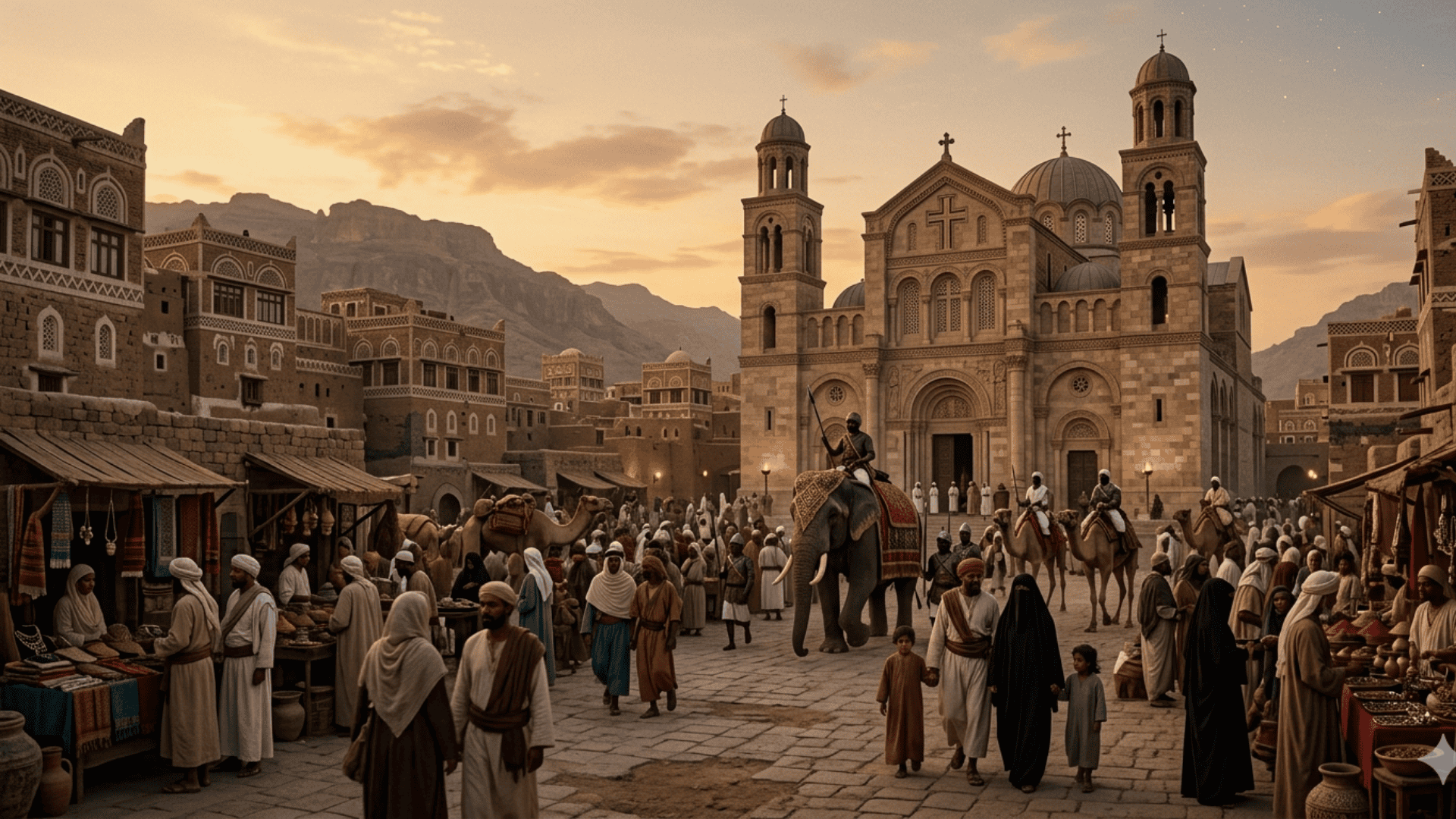
The Ethiopian general Abraha subsequently founded an independent Christian kingdom. He is credited with the construction of a monumental cathedral in Ṣan‘ā’ and expeditions to the north (including the "Elephant" campaign, mentioned in Islamic tradition in Surah 105). Arabia was then a confessional crossroads where Greek-speaking Christianity (Palestine), Syriac Christianity (the kingdom of al-Ḥīra), and Ethiopian Christianity intersected.
A Shared Spiritual and Linguistic Heritage
Islam crystallized in an environment deeply imbued with biblical culture, as evidenced by the religious lexicon used in the Quran.
The Divine Designation: The term Al-Raḥmān ("the Merciful") was already used by Jewish and Himyarite Christians in the form Raḥmānān. Similarly, the name Allah (al-Ilāh) was customary among the Christians of Najrān.
Linguistic Borrowings: Fundamental concepts stem from Syriac or Aramaic, such as ṣalāt (prayer), zakāt (alms), qur’ān (liturgical lesson), or sūra (writing).
An Intermediate Christology: In his inscriptions, Abraha used the formula "God and His Messiah." This formulation, less focused on divine filiation than Byzantine dogmas, seems to have been designed to suit local monotheistic sensibilities, prefiguring some christological themes later found in the Quranic text.
The Last Tremors of Late Antiquity
The end of the 6th century is marked by a geopolitical shift. Around 570, the Sassanian Persians expelled the Ethiopians from Yemen, transforming the region into a satrapy. This change introduced a Zoroastrian influence to the religious landscape just before Muhammad's birth, adding an ultimate layer to the region's spiritual complexity.
Conclusion
7th-century Arabia was not a world apart but a land of spiritual maturity where Jews, Christians, and other monotheists shared a common legal and cultural space. Muhammad addressed an audience familiar with biblical narratives and figures from the Old and New Testaments.
Far from being an ex nihilo rupture, the emergence of Islam appears to historians as the culmination of a long religious sedimentation, situated at the crossroads of the greatest civilizations of its time.