The authors of the Qur’an plagiarized ancient texts.
Sūrah 18 (al-Kahf) and the “Companions of the Cave”: A Literary Inheritance
Introduction
Sūrah 18 (al-Kahf) recounts the story of the “companions of the cave” (18 : 9–26), describing a group of young believers who fall into a miraculous sleep lasting 309 years and emerge unscathed to bear witness to the resurrection of the body. However, this account does not arise ex nihilo within the Qurʾānic tradition: it is largely inspired by the legend of the Seven Sleepers of Ephesus, which was widespread in both Christian and pagan Antiquity. As scholars unanimously note, “a remarkable coincidence of words, expressions, or narrative details” links the two texts[1]. More than a mere parallel, this filiation reveals the literary bricolage employed by the Qurʾānic redactors to offer a concise, edifying version of the legend tailored to their Arabic-speaking audience.
1. Origins and Transmission of the Ephesus Legend
Origins and First Transcriptions
Emerging in the 5th century as an oral tale, this story was first recorded in Syriac by Bishop Jacob of Sarug († 521). A few decades later, Gregory of Tours († 594) produced a Latin translation, thereby promoting its spread throughout the Western Christian world. Very quickly, this Latin version inspired further adaptations and translations into Greek, Arabic, Ethiopic, Coptic, and Armenian, demonstrating the universal appeal and richness of this narrative heritage.
Circulation before Islamization
Even before the rise of Islam, this tale circulated actively among Arabic-speaking Christian communities in Syria, Jordan, and Yemen. It was especially preserved in Syriac monasteries—true centers of both spiritual life and living libraries—where storytelling and meditation intertwined to nourish local faith and culture.
Origin and Nature of the Tradition
According to historian Thomas Eich, this story is not the product of a scholarly text or a courtly literary work, but rather of a popular tradition deeply rooted in Palestinian collective memory. Rather than being a formal document, it represents an oral heritage passed down through generations until ecclesiastical figures sought to preserve this narrative treasure in writing.
2. Key Narrative Parallels
Legend of the Seven Sleepers of Ephesus Qurʾān 18 : “Companions of the Cave”
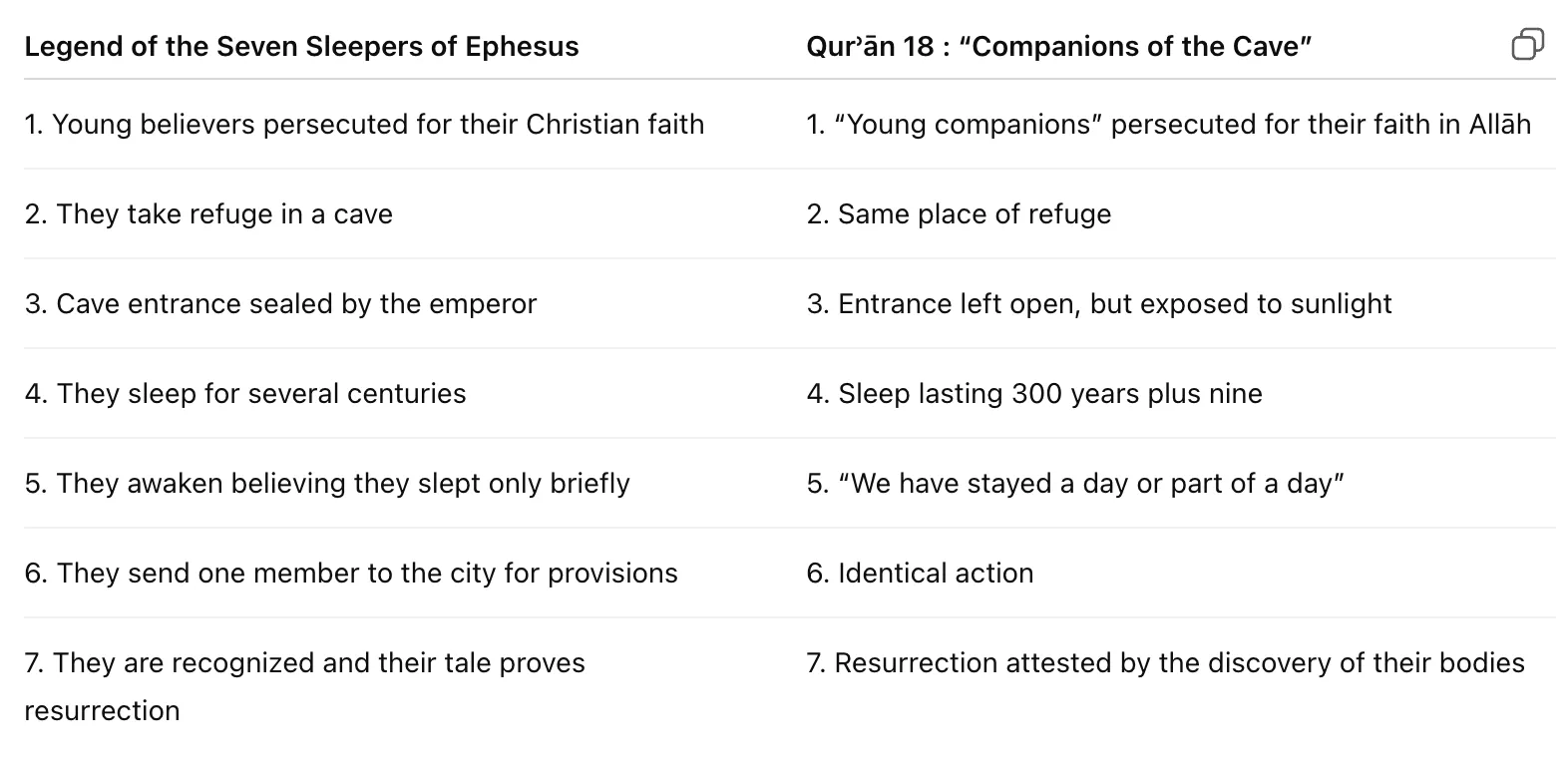
Partial Conclusion: The Qurʾānic narrative is almost exactly mirrored, its brevity serving as a homiletic summary for an audience already familiar with the full legend[5].
3. Mythological Sources and Mediterranean Folklore
A Mythic Reservoir Beyond Christian Legend
Far beyond the Christian legend, the authors of the Qur’an drew upon a much older mythic repertoire to shape their narratives. Among these traditions is a fascination with heroes miraculously preserved by long slumbers: Epimenides, who lay asleep in a cave for fifty-seven years before awakening; the Sardian “long sleep” that Aristotle mentions near the tombs of Heracles; and, at Ephesus, the tale of Endymion, a young man granted eternal sleep, attended by his faithful dog.
The Symbolic Role of the Cave
The cave emerges as a powerful symbol of rebirth and mystery. In Greek and Near Eastern antiquity, such caverns were perceived as places of mystical initiation and communion with the divine: Pan in his woodland haunts, Hecate under the veil of night, but also great Biblical figures such as David and Moses, and even Muhammad in the cave of al-Hira. These spaces exist outside ordinary time, offering the soul a sanctuary of purification before returning to the world.
The Doctrine of the Soul’s Sleep
This idea finds theological resonance among the Syrian Fathers, like Aphraates in the 4th century, who conceived of the soul as resting in sleep before the Resurrection. This doctrine echoes in several Qur’anic verses (10:45; 17:52; 20:103), where sleep becomes a metaphor for the transition between earthly life and eternal life. Thus, behind the Qur’anic account of the Sleepers lies a millennia-old heritage, woven from pagan, Judeo-Christian, and Eastern beliefs, which the redactors transformed into a powerful allegory of faith and hope.
4. The Qurʾānic Contribution
4.1. The raqm and the Guardian Dog
The Qurʾānic version adopts from the Christian corpus the mysterious al-raqm—likely the very “tablet” also mentioned in the Christian legend, its inscriptions inscribed on lead sheets. Far from a mere mark of ownership, this raqm becomes in Islamic tradition a silent Gospel of lead, its material weight echoing its spiritual significance: engraved in darkness, it seals the covenant between the sleepers and their fate.
At the cave’s entrance stands Kitmîr, the faithful dog. Absent from learned Latin accounts, he features prominently in popular oral tradition and in fifth-century magical amulets. As both earthly guard and supernatural sentinel, Kitmîr evokes Anubis of Egypt, Cerberus of Greek myth, and the Zoroastrian hound who watches the bridge of the dead. Through these twin symbols—the tablet and the canine—the Qurʾān reinvents the Christian tale, breathing new life into it by making both text and creature the threshold between the sacred and the profane.
4.2. A Cosmological Argument for Resurrection
Rather than dwelling on the masonry that sealed the sleepers—an emphasis of the Christian legend—the Qurʾānic narrative stages a cosmic theater. The cave becomes a dark sanctuary shielded from the sun’s relentless blaze. The reference to bodies turning on their sides (18:18) transforms these sleepers into seeds poised for germination under celestial nourishment: the repose is not mere narrative artifice but a sign of preparation for rebirth.
This imagery reaches back to the Pyramid Texts of ancient Egypt, which already celebrated concealment and ritual rest as instruments of divine resurrection. In this way, the Qurʾān does not simply appropriate the old legend; it transcends it, granting it cosmological depth in which natural protection and the celestial cycle stand as pillars of universal hope.
Conclusion
The Qurʾānic account of the “companions of the cave” is unquestionably heir to the legend of the Seven Sleepers of Ephesus—a legend itself woven from a patchwork of oral traditions and Mediterranean myth. The Qurʾān transforms this literary fiction into “true history” (ḥaqq), not for novelty’s sake, but to serve its doctrinal aim: to convince readers of bodily resurrection through a succinct narrative homily for an already informed audience. This provides yet another indication that the Qurʾānic composition does not strictly align with later Islamic tradition.
References :
Sidney Griffith, “Christian lore and the Arabic Qur’ān: the ‘Companions of the Cave…’,” in The Quran in Its Historical Context, Routledge, 2007, p. 110.
Michael Huber, Die Wanderlegende von den Siebenschläfern, Harrassowitz, 1910.
Geneviève Gobillot, “Gens de la Caverne,” in Dictionnaire du Coran, Robert Laffont, 2007, p. 363–364.
Thomas Eich, “Muḥammad und Cædmon… die Siebenschläferlegende,” Der Islam 100(1), 2023, p. 7–39.
Gabriel S. Reynolds, The Qur’an and Its Biblical Subtext, Routledge, 2008, p. 167.
Diogenes Laërtius, Lives and Opinions of Eminent Philosophers, I, 10.
Aristotle, Physics, IV, 218 b.
Sean Anthony, Muhammad and the Empire of the Faith, UC Press, 2020, p. 167.
Yulia Ustinova, Caves and the Ancient Greek Mind, Oxford UP, 2009.
J. E. Walters, “Sleep of the Soul and Resurrection of the Body,” Hugoye 22(2), 2019.
Karl Preisendanz (ed.), Papyri graecae magicae II, Teubner, 1994, p. 213–214.
Farouk Yahya, “Talismans with the Names of the Seven Sleepers,” in Malay-Indonesian Islamic Studies, Brill, 2023.
Geneviève Gobillot, “Die ‘Legenden der Alten’ im Koran,” in Groß & Ohlig (eds.), Die Entstehung einer Weltreligion II, Inârah Hans Schiler, 2012, p. 673–674.
Pyramid Texts, cited by Gobillot, art. cit., p. 673.