Reason and Revelation: The Debate Between Ash'arites and Mu'tazilites
Introduction
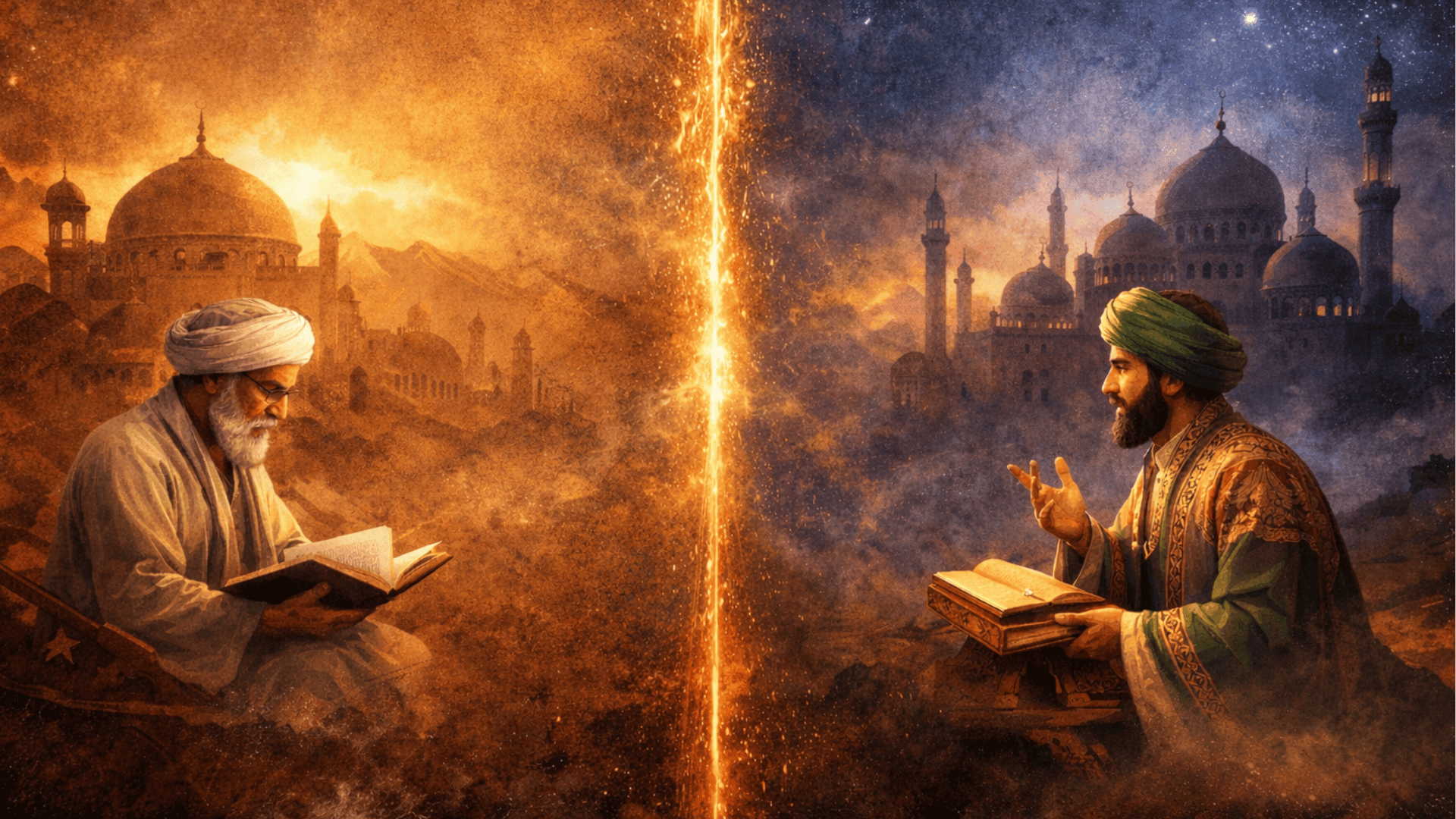
Theological debates have played a central role in the development of Islamic thought. Among the most significant is the controversy between the Muʿtazilites, advocates of a rationalist approach, and the Ashʿarites, who later came to represent classical Sunni orthodoxy. This debate addresses fundamental questions concerning the nature of God, particularly the relationship between His essence and His attributes, the nature of the Qur’an, and the possibility of seeing God in the hereafter. Understanding these differences helps illuminate the philosophical and theological issues that shaped the history of kalām (Islamic theology).
The Debate Between Ashʿarites and Muʿtazilites
The theological debate between the Ashʿarites, representatives of classical Sunni orthodoxy, and the Muʿtazilites centers on several fundamental questions related to the nature of God and Islamic metaphysics. Three major disagreements structure this debate.
1. The Relationship Between the Divine Attributes and the Essence of God
The first controversy concerns how the divine attributes should be understood.
The Muʿtazilites defend the principle of divine simplicity. According to them, God is an absolutely simple and non-composite essence. Attributes such as knowledge, power, or will are not distinct realities; rather, they are identical with the divine essence. Thus, God is knowing by His very essence, not through an attribute of knowledge that would be added to Him.
The Ashʿarites, on the other hand, maintain that the attributes are distinct from the essence at the conceptual level (mafhum), though they are not separate from it in existence (wujūd). Their famous formulation summarizes this view: the attributes “are not the essence, yet they are not other than the essence.” They criticize the Muʿtazilite position by arguing that if the attributes were strictly identical with the essence, then knowledge and power would become the same reality, which raises logical problems since their scopes differ.
2. The Question of the Creation of the Qur’an
Another major point of disagreement concerns the nature of the divine speech.
The Muʿtazilites maintain that the Qur’an is created (makhlūq). Their argument is that the Qur’an consists of letters and sounds and appeared within a specific historical context. Because it is connected to time and language, it must therefore be considered a creation of God.
The Ashʿarites, however, affirm that the Qur’an is uncreated, as it corresponds to the eternal attribute of God’s speech. To resolve the difficulty related to the material form of the text, they distinguish between two dimensions:
Kalam nafsī, the inner and eternal speech of God
Kalam lafẓī, its spoken or written expression in the created world
3. The Vision of God in the Hereafter (Ru’ya)
The possibility of seeing God in the hereafter is another point of disagreement.
The Muʿtazilites argue that seeing God is rationally impossible. In their view, vision necessarily implies direction, location, and physical limits, which would contradict God’s absolute transcendence. They therefore interpret Qur’anic verses referring to the “vision” of God metaphorically, as meaning the expectation of divine reward.
The Ashʿarites, in contrast, affirm that the vision of God will be possible in the hereafter. However, they do not understand it as a physical vision subject to the ordinary laws of perception such as distance, light, or bodily organs. Rather, they describe it as a form of direct metaphysical apprehension or knowledge that does not require spatial localization.
Why Do the Muʿtazilites Reject the Analogy Between Humans and God?
The Muʿtazilite rejection of any analogy between God and humans aims primarily to preserve the absolute unity (tawḥīd) and transcendence of God.
1. Preserving Divine Transcendence
For the Muʿtazilites, God is radically transcendent. Any comparison with human beings risks attributing to God characteristics proper to created beings, such as limits, direction, or spatial location. For example, they reject the idea of a literal visual perception of God because it would imply physical conditions incompatible with His infinite nature.
2. The Doctrine of Divine Simplicity
Unlike human beings, who are composed of many properties and characteristics, God for the Muʿtazilites is a simple essence.
In human beings, attributes can be distinguished from the individual: one may speak of a “learned man” or a “writing man.” In God, however, attributes are not added to the essence; they are identical with it. Affirming distinct attributes would, in their view, introduce composition into the divine essence.
3. The Use of Negative Theology
The Muʿtazilites also favor a negative theological approach. Rather than defining God through analogy with human realities, they prefer to describe what God is not. Human concepts, derived from sensory experience and observation, cannot adequately capture an infinite metaphysical reality.
4. The Rejection of Analogical Predication
Finally, the Muʿtazilites argue that the terms used to describe God (such as “merciful” or “powerful”) function only as conceptual tools for human understanding. They do not imply a real similarity between God and created beings. The distinctions we observe among attributes in the created world should not be projected onto the divine reality.
Conclusion
The debate between the Muʿtazilites and the Ashʿarites illustrates one of the major intellectual tensions in the history of Islamic theology: the relationship between the primacy of reason and the authority of revelation in interpreting religious truths. Through issues such as the relationship between the divine essence and attributes, the nature of the Qur’an, and the possibility of seeing God in the hereafter, these two schools developed different approaches to preserving both the unity and transcendence of God.
The Muʿtazilites sought to defend a rigorously rational conception of the divine, emphasizing the absolute simplicity of God’s essence and rejecting any analogy that might lead to anthropomorphism. The Ashʿarites, meanwhile, attempted to reconcile rational inquiry with the authority of revealed texts by developing theological distinctions that affirm divine attributes while safeguarding God’s transcendence.
Although their positions differ, both traditions made decisive contributions to the development of kalām and to the enrichment of theological reflection within Islam. Their dialogue—sometimes conflictual yet deeply intellectual—demonstrates the richness and diversity of approaches that have shaped Islamic thought throughout its history.