Surah 21:30 and the Question of the “Scientific Miracle”
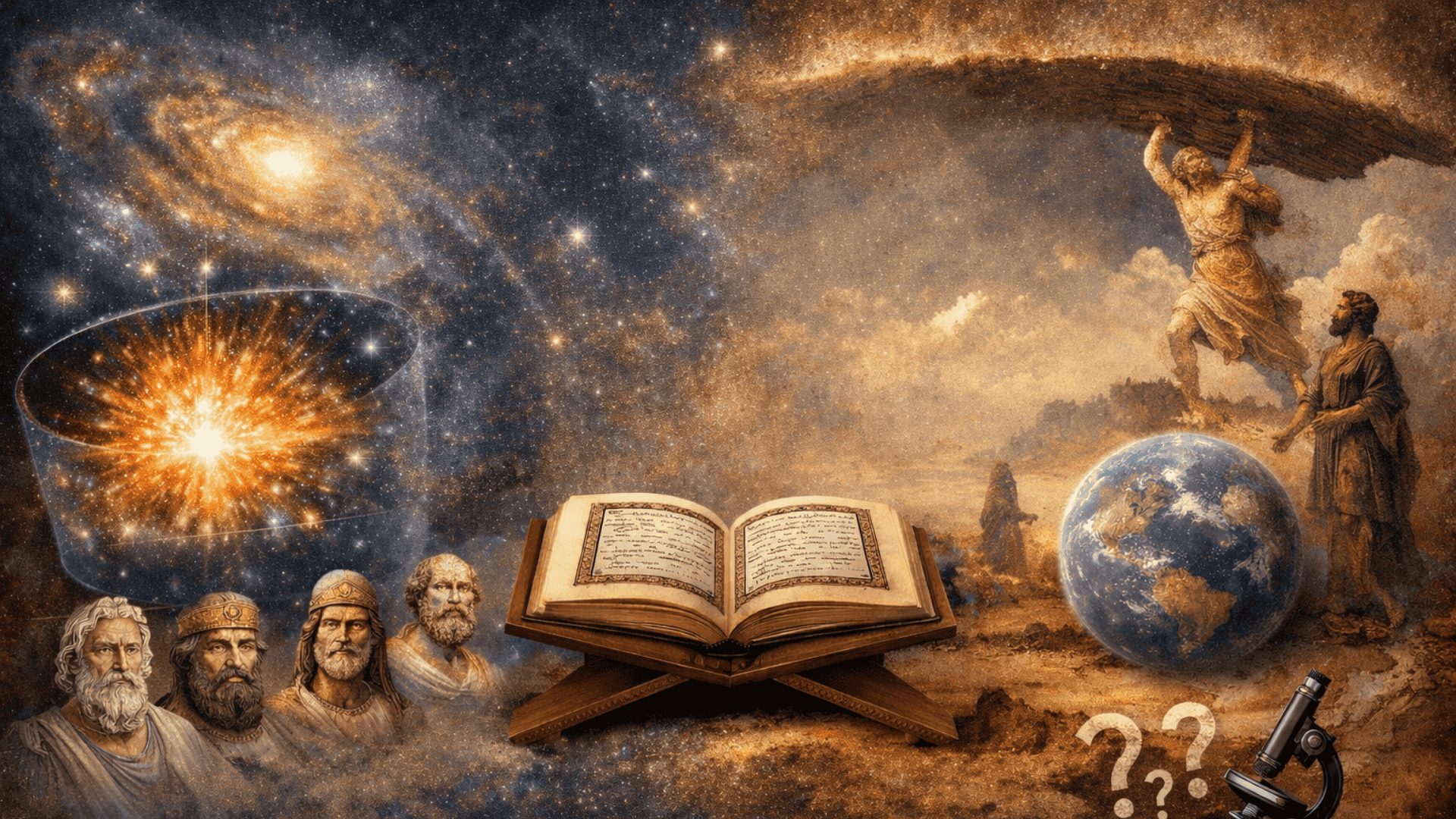
The Qur'anic Verse
Surah 21 (Al-Anbiyā), verse 30: “Have those who disbelieved not considered that the heavens and the earth were a joined entity, and We separated them, and made from water every living thing? Then will they not believe?”
This verse is sometimes interpreted by some believers as a reference to the Big Bang, the modern cosmological theory that describes the origin and expansion of the universe.
However, the interpretation of this passage is debated. Several scholars and critics argue that the verse does not necessarily correspond to a modern scientific description of the origin of the universe.
The Question of the Nature of the “Heavens”
In Qur'anic language, the term “heavens” (samāʾ) can have several meanings: the firmament, the celestial vault, or the visible universe.
From a modern scientific perspective, what we call the sky or the heavens essentially refers to cosmic space, which is largely composed of vacuum and contains galaxies, stars, and other cosmic structures.
In this context, some critics point out that the expression referring to a “joined mass” of the heavens and the earth does not directly correspond to current scientific models.
Chronological Differences According to Modern Cosmology
Contemporary cosmology estimates that:
the universe is about 13.8 billion years old;
the Earth formed about 4.5 billion years ago.
This means that the Earth appeared long after the formation of the universe, not simultaneously with it.
Some commentators therefore conclude that the wording of the verse reflects an ancient cosmological worldview rather than a precise scientific description.
Similar Ideas in Ancient Cosmologies
The idea that heaven and earth were once united and later separated is not unique to the Qur’anic text. Similar motifs appear in several ancient traditions.
The Epic of Gilgamesh
In some ancient Mesopotamian traditions, it is mentioned that the heavens and the earth were separated at the origin of the world.
Euripides
The Greek tragedian Euripides also referred to the idea that, in the beginning, heaven and earth formed a single unity before being separated.
Anaxagoras
The Greek philosopher Anaxagoras proposed that all things were initially mixed together in an indistinct mass before an intellectual principle (Nous) organized and separated the elements.
Interpretations and Debates
These parallels have led some scholars to suggest that the cosmological representations found in religious texts belong to a broader intellectual context shared by several ancient civilizations.
For believers, this verse may be interpreted as a symbolic or theological expression of divine creation.
For critics, it may instead reflect ancient cosmological ideas common to multiple cultures.
Conclusion
The question of whether certain religious passages contain scientific anticipations remains widely debated. Interpretations vary depending on theological, historical, or scientific perspectives.
Studying these texts highlights the importance of the cultural and intellectual context in which they were written, as well as the diversity of interpretations they continue to inspire today.